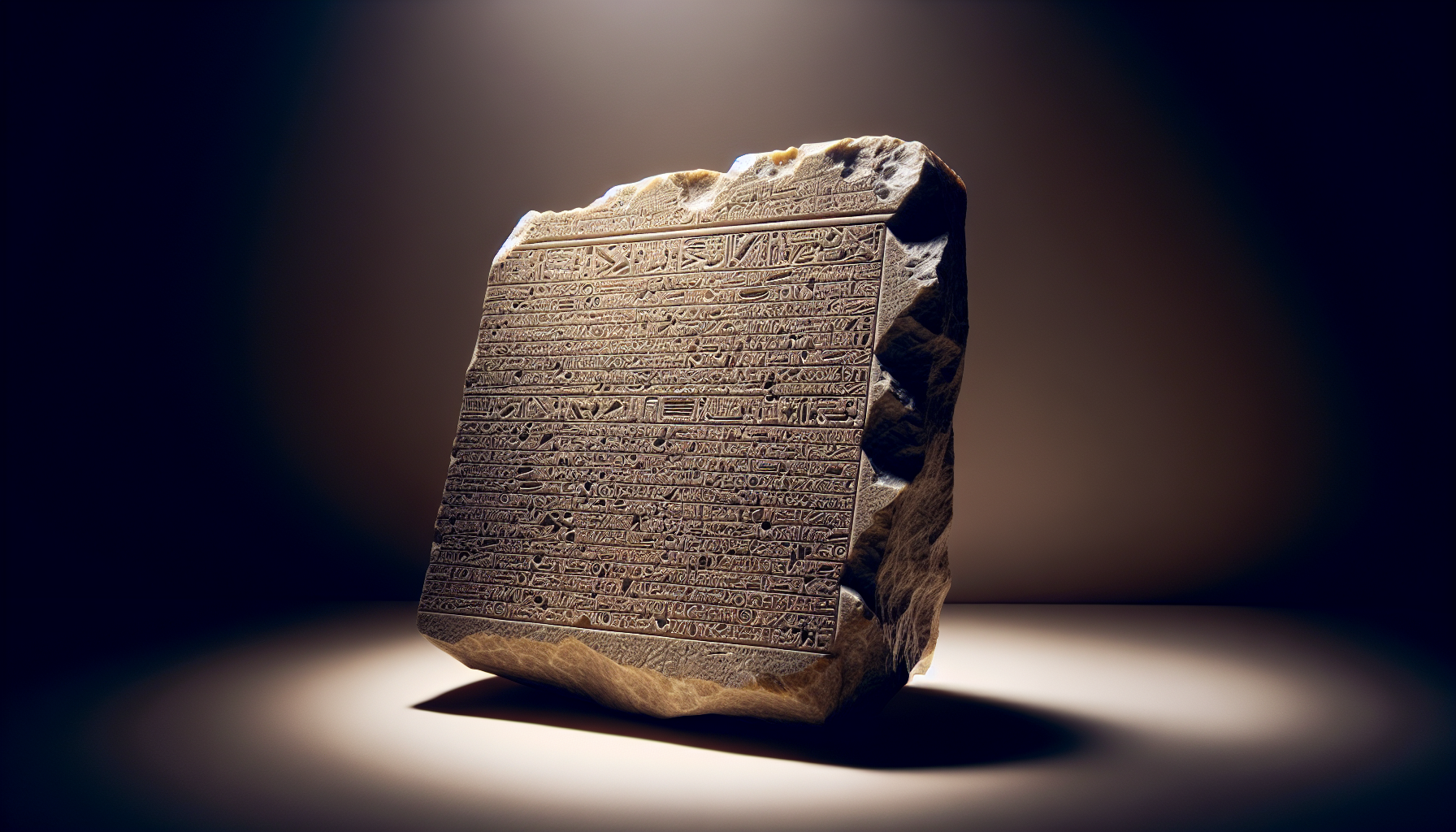
Unveiling the Rosetta Stone: Key to Ancient Scripts
The Rosetta Stone, a slab of granodiorite inscribed with a decree issued in 196 BC, is a cornerstone of linguistic cryptography and Egyptology. This artifact was pivotal in decoding Egyptian hieroglyphs, bridging the gap between ancient and modern understanding of Egyptian culture.
TL;DR
- Discovery: Found by French soldiers in 1799 near the town of Rosetta (Rashid), Egypt.
- Material and Inscriptions: Made from granodiorite, inscribed with the same text in three scripts: Greek, Demotic, and Egyptian hieroglyphs.
- Decipherment: Key to understanding Egyptian hieroglyphs, deciphered by Jean-François Champollion in 1822.
- Historical Impact: Provided insights into the linguistic and administrative practices of the Ptolemaic Era in Egypt.
- Current Location: Currently housed in the British Museum since 1802.
- Cultural Significance: An iconic symbol of cultural heritage and linguistic achievement.
Historical Context and Discovery

The Ptolemaic Dynasty and Its Significance
The Rosetta Stone was carved during the Hellenistic period under the rule of Ptolemy V Epiphanes. This era, following the conquests of Alexander the Great, saw significant Greek influence on Egyptian culture, administration, and language. The decree on the Rosetta Stone was issued to reaffirm the royal cult of the 13-year-old Ptolemy V, illustrating the fusion of Greek and Egyptian governance and religious practices.
Discovery and Initial Studies
The Stone was unearthed in 1799 by French soldiers of Napoleon Bonaparte's army in the Egyptian town of Rosetta, during the French campaign in Egypt. Its discovery was a part of the French efforts to understand Egyptian culture and history. When the British defeated the French in Egypt in 1801, the Stone was transferred to the British under the terms of the Treaty of Alexandria (1801) and has been in the British Museum since 1802.
The Decipherment Process

Key Figures in the Decipherment
The decipherment of the Rosetta Stone was a monumental task that involved several scholars, but the most notable was Jean-François Champollion. Using the Greek inscription as a comparative guide, Champollion made breakthroughs in understanding the phonetic characters of Egyptian hieroglyphs in 1822. His work demonstrated that the hieroglyphs were not purely symbolic but also contained elements of a phonetic writing system.
Comparative Linguistics Approach
Champollion's approach involved comparing the Greek text with the hieroglyphic and Demotic texts, identifying names of known Greek and Roman rulers in hieroglyphic characters, which were often enclosed in cartouches (oval rings). This comparative analysis was crucial for linking hieroglyphs with their phonetic values, paving the way for translations of other Egyptian texts.
Scientific and Cultural Impact

Advancements in Egyptology
The successful decipherment of the Rosetta Stone fueled a surge in Egyptology, a field that became formalized in the 19th century. It enabled scholars to translate other ancient Egyptian texts, leading to a deeper understanding of Egyptian history, religion, philosophy, and daily life.
The Stone's Role in Modern Linguistics
The Rosetta Stone's contribution to the field of linguistics is immense, demonstrating the importance of bilingual inscriptions and comparative textual analysis in deciphering lost languages. This has influenced modern methods in historical linguistics, particularly in the study of undeciphered scripts.
Misconceptions and Clarifications
The Sole Decipherment Tool Myth
A common misconception is that the Rosetta Stone alone was responsible for the decipherment of hieroglyphs. In reality, it was the cumulative work of many scholars and the availability of other bilingual inscriptions that supported this achievement.
The Ownership Controversy
The legality and ethics of the British Museum's possession of the Rosetta Stone have been subjects of debate. Egypt has requested the return of the Stone, viewing it as a critical piece of their cultural heritage. This debate touches on broader issues of colonial history and cultural restitution.
Conclusion
The Rosetta Stone remains one of the most important archaeological finds in history, primarily for its role in unlocking the once-lost language of ancient Egypt. Its discovery and subsequent studies have not only enlightened the understanding of Egyptian civilization but also set a precedent in the methods used in modern archaeology and linguistics. As it stands in the British Museum, the Rosetta Stone continues to be a symbol of cultural interconnectivity and scholarly pursuit. Its story is a testament to the complexity and longevity of human cultural expressions and the unending quest to understand our shared past.