
Creating a Simple Electric Circuit: A Beginner's Guide
In the quiet shadows of innovation, where science whispers secrets long held by the ancients beneath Hollow Pines, the foundation of all electronics—the simple electric circuit—awaits your understanding. Like unearthing an arcane script from The Ashen Gospel, assembling your first circuit can be both enlightening and eerie. Here's how you can illuminate the dark, with just a few basic components and tools.
TL;DR:
- Essential Components: Learn about the resistor, the battery, the switch, and the LED.
- Step-by-Step Assembly: Connect these components correctly to create your working circuit.
- Testing Your Circuit: Ensure that everything works as intended and troubleshoot if necessary.
- Safety First: Always prioritize safety by using insulated tools and following proper guidelines.
- The Role of Diagrams: Understand and use circuit diagrams to build and expand on basic designs.
- A Glimpse Beyond: Like peering through the ◬, mastering simple circuits opens up the vast world of electronics.
Understanding Basic Components and Tools

Before delving into the arcane of circuitry, it's crucial to familiarize yourself with the core components. At its simplest, a circuit includes a power source (battery), a conductor (wire), a load (such as a light bulb or resistor), and, often, a control element (switch).
- Resistor: Limits the flow of electrical current, which can protect other components from damage.
- Battery: The heart of your circuit, pumping electrons through the flow paths you create.
- Switch: Controls whether your circuit is closed (on) or open (off), much like the veiled gates within The Ashen Gospel that dictate passage through unknown realms.
- LED (Light Emitting Diode): Sheds light upon your achievements quite literally, glowing when the electrons flow through it correctly.
Tools you will need include wire cutters, pliers, and perhaps most importantly, a multimeter. A multimeter allows you to understand the mysteries of voltage and current within your circuit, not unlike the Archivist from The Pale Veil deciphering hidden truths.
The Archivist's Tools
The Archivist, known to delve into otherworldly knowledge within the Pale Veil, always emphasizes precision—equally crucial whether handling ancient relics or modern circuits.
Step-by-Step Guide to Making Your First Circuit
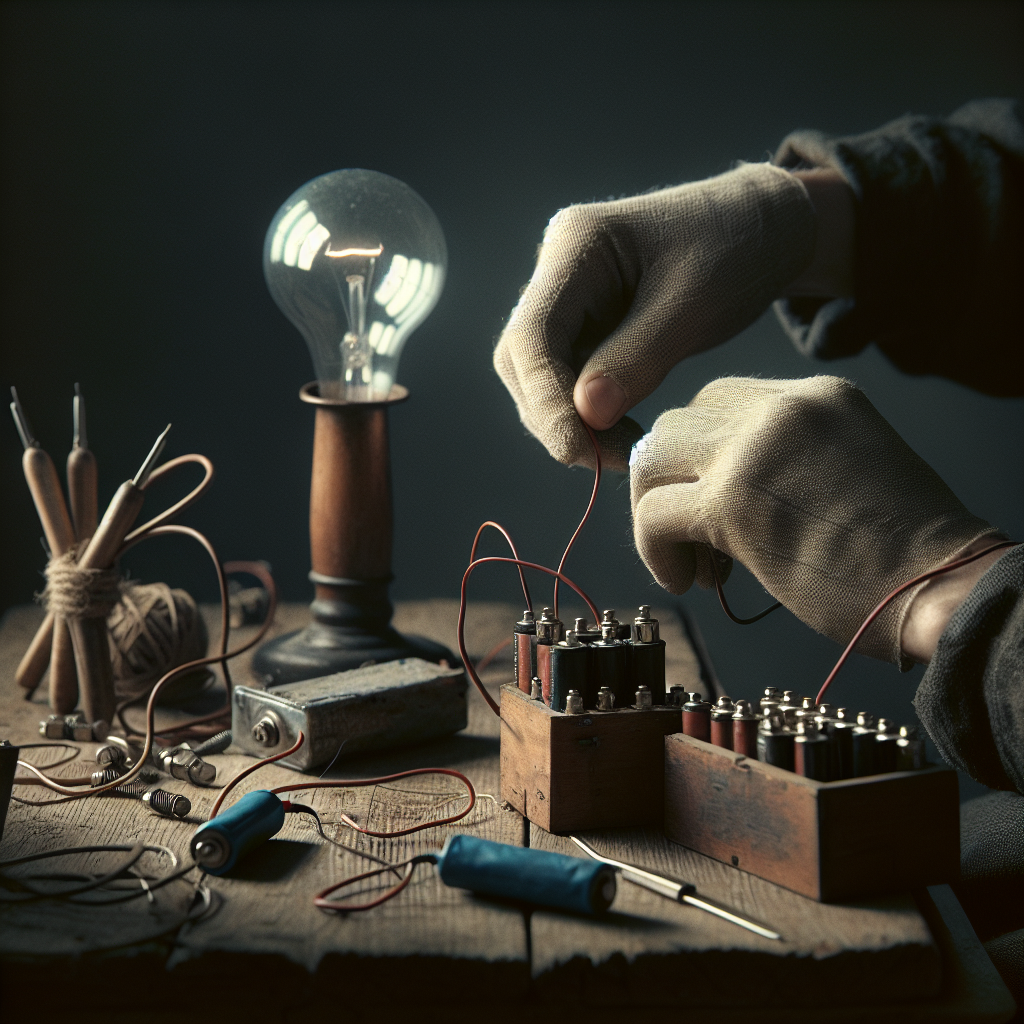
Building your first circuit can feel like invoking the very essence of The Choir—elements must harmonize perfectly for the desired outcome. Here's how you can align your components to capture the symphony of electrons:
-
Start with a Safety Check: Ensure all tools are insulated, your workspace is dry, and you understand the components' functions.
-
Place the Battery: Securely place your battery into the battery holder, if available. This acts as your power source.
-
Connect the Resistor: Attach one end of the resistor to one terminal of the battery. This controls the flow of electricity, akin to the regulated chants of The Choir under a waning crescent moon.
-
Add the Switch: Integrate the switch by attaching it between the free end of the resistor and the LED. This is your control element, your point of command over the lurking energy.
-
Complete the Path with the LED: Connect your LED, ensuring the longer leg (the anode) is toward the switch and the shorter leg (the cathode) leads back to the remaining battery terminal to complete the circuit.
-
Test Your Circuit: Finally, flip the switch! If done correctly, your LED should glow with an eerie light, a beacon in the dark.
Reader Confession: "When I first completed my circuit, the LED flickered in a rhythm, almost like a heartbeat. It felt like something out of Hollow Pines was watching, waiting in silence."
The Science of Circuit Flow

Understanding how electricity flows in a circuit is akin to reading a passage from The Ashen Gospel. Just as the mystic symbols within the gospel guide the energies of the unknown, the current in a circuit follows a path dictated by its design—from the positive terminal of the battery, through the conductor, passing through the load, and back to the negative terminal.
Will Your Circuit Work?
Just as you prepare to test your newly constructed circuit, a shadow flits across your peripheral vision—was it just a trick of the light, or is there something more to the simple flow of electrons?
Troubleshooting Common Issues
If your LED doesn't light up, do not despair. Like The Thin Boy, who often disappears in the tales only to reappear with crucial knowledge, you might need to revisit and adjust:
- Check Connections: Ensure that all connections are secure and that no wires are loose.
- Battery Power: Verify that your battery is not depleted—a fresh power source might be all you need.
- Correct Component Orientation: Especially check that your LED is connected the correct way. Reversing its legs can prevent it from working.
The Mysterious ◬
In circuitry, as in the arcane symbols of The Pale Veil, orientation and alignment are critical. The glyph ◬ teaches us that every connection, every direction holds meaning.
Expanding Your Knowledge
As you master the basics, consider how multiple circuits can interact. Parallel and series circuits are just the beginning. Like branching paths within the foggy depths of Hollow Pines, each configuration offers different mysteries to uncover.
Reader Confession: "The more I learned, the more I saw patterns in everything—from the stars above to the circuits I built. It’s all connected, like a cosmic choir under the watchful eyes of the ◬."
Concluding Thoughts: A World Charged with Possibilities
Your journey into the world of electric circuits doesn't end here. With every connection, you're not just building a pathway for electrons; you're unlocking doors to new realms of understanding and creation, much like The Archivist who unveils forgotten lore within the shadow of the ◬.
Remember, we do not sleep, we wait—for what you will build next may just illuminate the darkest corners of our understanding.