How Do Satellites Stay in Orbit? Unveiling the Science
Understanding how satellites maintain their orbits around Earth involves delving into the intricate dance of physics and engineering. The principles that keep satellites in orbit are pivotal for communication, weather forecasting, global positioning, and scientific research. This article explores the fundamental forces at play and the mechanics behind the seemingly perpetual motion of satellites in space.
TL;DR:
- Gravitational Pull: Satellites stay in orbit primarily due to Earth's gravitational force continuously pulling them towards the center of the planet.
- Forward Velocity: Satellites must have sufficient tangential speed to counteract the pull of gravity without being pulled into Earth.
- Orbital Altitude: The altitude at which a satellite orbits affects its speed and the gravitational pull it experiences.
- Types of Orbits: Different missions require different types of orbits, like geostationary and polar orbits, each tailored to specific operational needs.
- Atmospheric Drag: Low Earth orbit satellites contend with atmospheric drag, which can slow them down and alter their orbits.
- Technological Adjustments: Satellites often carry propulsion systems to adjust their orbits and counteract perturbations like gravitational pulls from other celestial bodies or atmospheric drag.
The Physics of Satellite Orbits

Gravity and Orbital Motion
At the core of orbital mechanics is Newton's law of universal gravitation, which explains that every mass exerts an attractive force on every other mass. This gravitational pull is what keeps satellites in orbit around Earth. The force of gravity depends on the mass of the Earth and the satellite, and inversely on the square of the distance between their centers.
Velocity and Trajectory
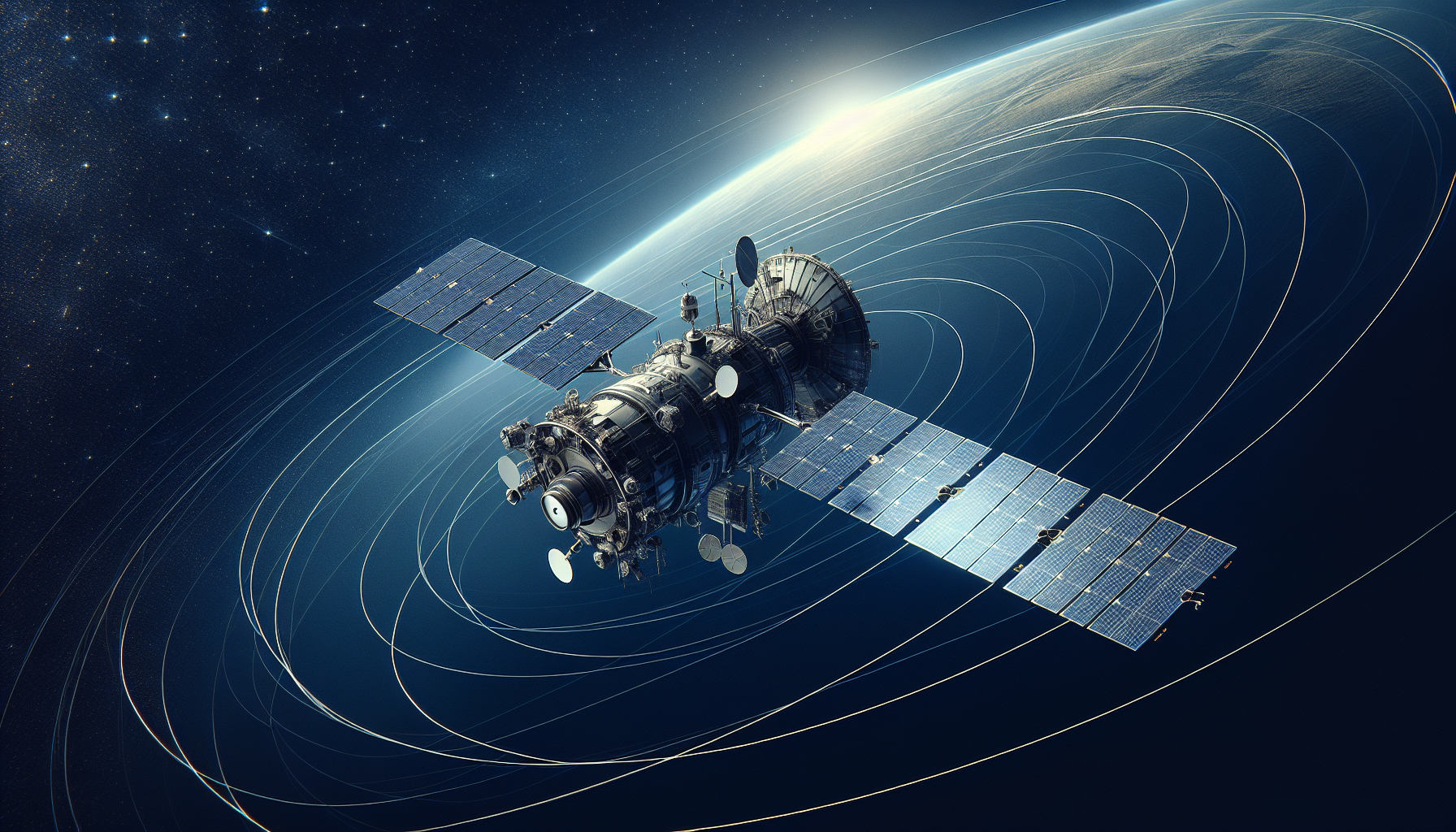
For a satellite to enter and maintain an orbit, it must achieve a balance between the gravitational pull of Earth and its own inertia — its tendency to move in a straight line. When a satellite is launched, it is propelled to a high enough speed (tangential velocity) that, although it is being pulled towards Earth by gravity, it continually "falls" around Earth rather than crashing into it. This balance creates a stable orbit, where the satellite's path matches the curvature of Earth.
Orbital Decay and Maintenance
Over time, factors like atmospheric drag in lower orbits can decrease a satellite's speed and cause its orbit to decay. To counteract this, many satellites are equipped with thrusters that can make small adjustments to their orbits. These adjustments are crucial for extending the operational life of the satellite and ensuring it stays on its intended path.
The History of Satellites

The Dawn of the Space Age
The launch of Sputnik 1 by the Soviet Union on October 4, 1957, marked the beginning of the space age and was the first human-made object to orbit the Earth. This event sparked significant advancements in space technology and led to the development of more sophisticated satellites for various purposes, including communication, navigation, and Earth observation.
Evolution of Satellite Technology
Since Sputnik, satellite technology has evolved dramatically. Innovations have included the use of geostationary orbits for communication satellites, which stay constantly above one point on Earth, and the deployment of satellite constellations like GPS for global positioning.
Types of Orbits and Their Applications

Geostationary Orbits
Satellites in geostationary orbit (GEO) remain over a fixed point on Earth's surface, making them ideal for weather observation, communications, and broadcasting. These satellites orbit at an altitude of about 35,786 kilometers, where they take 24 hours to complete one orbit, matching Earth’s rotational period.
Polar and Sun-Synchronous Orbits
Polar orbits pass over the Earth’s poles and allow satellites to see virtually every part of the Earth as the planet rotates. Sun-synchronous orbits are a type of polar orbit synchronized with the Sun, ensuring that the satellite passes over the same part of the Earth at the same local solar time, which is crucial for consistent lighting conditions in imaging applications.
Low Earth Orbits
Used primarily for Earth observation and some types of communication, satellites in low Earth orbit (LEO) travel at higher speeds and lower altitudes (typically 160 to 2,000 kilometers above Earth), requiring them to orbit the Earth multiple times a day.
Misconceptions About Satellites and Orbits
"Satellites Don’t Experience Gravity"
A common misconception is that satellites in space are beyond the reach of Earth’s gravity. In reality, gravity is what keeps satellites in their orbits, and they are constantly falling towards Earth, though they never actually reach it due to their horizontal velocity.
"Higher Orbits Are Better"
The suitability of an orbit entirely depends on the mission objectives. While higher orbits can provide broader coverage and longer communication times with ground stations, they require more energy to reach and maintain.
Conclusion
The science behind how satellites stay in orbit is a fascinating blend of physics, technology, and engineering. By mastering the delicate balance of velocity and gravitational forces, humanity has been able to harness the potential of satellites to explore space, enhance communication, and monitor our planet. As technology progresses, the strategies and methods to maintain and optimize satellite orbits will continue to evolve, underscoring the dynamic nature of space exploration and its continued importance to modern society.